
For 17 years leading up to the collapse, reports cited structural problems with the bridge, and the federal government rated it as “structurally deficient” — a rating given to approximately 75,000 other U.S. bridges in 2007.
Transportation experts across the public and private sectors agree that the U.S. infrastructure is in peril, a sentiment that’s supported with startling statistics from a 2011 study called Failure to Act, by the American Society of Civil Engineers (ASCE).
The report assigns real economic impacts to a status quo path for American transportation. It further asserts that America’s deficient roads, bridges and transit systems bring tangible economic consequences to U.S. businesses, with ramifications acutely felt in every household as well. And these effects will continue to grow unless the nation pumps significant investment into its crumbling transportation infrastructure. By 2020, businesses will pay $430 billion in increased transportation costs. U.S. exports will shrink to the tune of $28 billion annually, and individual household incomes would experience a related hit, with a $7,000 annual reduction predicted.
Legislation passed in 1956 authorized the creation of the interstate highway system. Experts estimate the average lifespan of highways and bridges at about 50 years, which explains why the vast majority of Federal Highway Administration (FHWA) funding today is spent on maintenance to existing roads and bridges.
But with the U.S. population expected to approach 400 million in 25 years, many leaders say this “patch and repair” strategy may not be sustainable. What technologies are driving tomorrow’s transportation infrastructure? Will today’s pilot programs and trials be broadly used in the next quarter century? What new innovations barely conceived of today might be commonplace in 2037?
Blaine Leonard, past president of ASCE, says that despite the well documented funding challenges facing U.S. infrastructure, there is reason for optimism. “The fact that we can connect to the Internet on a phone in our pocket that has more computing power than was on the Apollo craft that went to the moon … it blows my mind,” he said. “When we look out 25 years, some things will happen that we can’t even conceive of because we’ll have the ability to do things that we don’t even know about today.”
Cars Talking to Cars
Transportation professionals across government and industry are paying close attention to several so-called “connected vehicle” pilot programs, which have the potential to dramatically reduce vehicle collisions. Smarter cars with the capacity to communicate with one another via wireless communications devices can alert drivers of threats to their safety, reducing crashes by as much as 80 percent.
Communicating Cars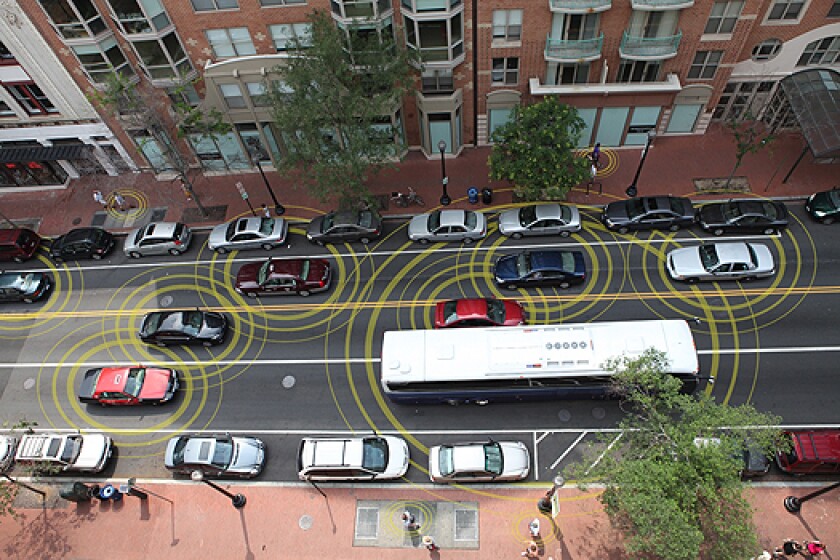
|
Scott Belcher, president and CEO of the Intelligent Transportation Society of America, a nonprofit trade group representing both public agencies and private companies involved in transportation, says the impacts of connected vehicles on the future of U.S. transportation cannot be overstated.
The U.S. Department of Transportation will use data gathered in current trials to determine future requirements for automobile manufacturers related to connected vehicles. Experts believe new cars will need to be equipped with connected vehicle sensors within the next few years.
The data collected will be transmitted to traffic management centers, allowing government agencies to make more informed decisions on how to maximize the efficiency of their transportation infrastructure.
A Word About Big Data
Belcher also notes that many government agencies are operating integrated traffic management centers, where emergency responders and law enforcement share space and intelligence alongside local transportation officials. This trend, he predicts, will grow in the years to come.“Currently there are multiple traffic data sets in any given city,” said Belcher. The state and city, as well as transit and safety organizations, collect data for different reasons and usually don’t share it, he added.
Many jurisdictions publishing open data today are finding their greatest successes in public transit, as private software developers are creating interesting mashups that capitalize on multiple data sets, often from different agencies. Belcher argued that aggregating this data en masse can reduce the need for additional infrastructure construction and drive additional innovation not yet imagined.
“As we go forward, cities, regions, states are going to scrape all of that data, normalize it, and use it for broad data analytics,” he said, “which will allow regions and states to optimize their transportation systems across modes, across regions and across cities.”
Monitoring Bridge Health
According to the FHWA, roughly 25 percent of the 600,000 bridges in the U.S. need to be replaced or repaired. The I-35W bridge collapse is widely cited as motivation by engineers working on wireless sensing technology that can help detect structural shortcomings in time to make needed repairs.
A Better Way to Build Bridges?
|
“Due to the advances in sensor technology, communication and more important, the miniaturization of all these electronics, it has become very practical,” he explained. “We can develop the systems to monitor bridge health in real time.”
Several different kinds of sensors are currently being piloted. Accelerometers capture bridge vibrations generated by vehicle traffic, but offer little information on localized damage, Yuan said. Piezoelectric sensors capture acoustic emission signals, offering a glimpse into potential structural vulnerabilities. Much of Yuan’s research is focused on harvesting sufficient energy over low frequency ranges to power the sensors and their wireless data transmissions back to central computers to enable effective analysis.
“I believe that 25 years from now, almost every bridge, existing or new, can use a wireless sensor system in a very economical way,” Yuan said. While sensors can be utilized on existing structures, incorporating them into the planning process for new bridges can potentially save money. More effective monitoring, he believes, can ease certain construction requirements and perhaps reduce visual inspection needs.
Smart Parking and Tolling
Experts agree that an influx of funding for transportation infrastructure in the next decade is unlikely. Planners now well versed in working with tight budgets are increasingly looking at how to make the most of their current transportation resources. Many jurisdictions are piloting solutions that are expected to see widespread adoption in coming years.“Especially in urban environments, you’re not going to see a lot of new construction,” Belcher said. “You’re going to see a lot of attempts to try to optimize the existing infrastructure that we have.”
A perfect example now in use in major urban centers like New York City, San Francisco and Los Angeles is technology that simplifies the hunt for the ever-elusive parking space. Studies have shown that a significant percentage of urban traffic congestion — 30 percent, to be exact — is caused by drivers circling in search of parking.
Smart parking technologies use wireless sensors to keep tabs in real time on available parking. This data is then available to drivers via a smartphone app, helping ease parking search congestion.
Many municipalities also are looking into demand-based parking rates, intended to be high enough to ensure some spaces remain available, but low enough to entice some drivers to use them. A pilot in San Francisco devotes all revenue from demand-based parking toward public transit.
A similar prediction is offered for the widespread adoption of congestion-based toll collection. Now in use in major cities including Washington, D.C., the practice discourages peak time travel when major bridges and roadways are likelier to resemble parking lots, while simultaneously generating money from drivers willing to pay a premium for a prime-time shortcut.
A proposal being considered in Northern California aims to help ease congestion and pay for transportation improvements using GPS trackers installed in vehicles. Drivers would be taxed per mile traveled, with surcharges for driving during periods of heightened congestion. This too, experts say, may be the wave of the future, with such a model eclipsing the gas tax as a primary means of funding transportation infrastructure.
Greening Transportation
Growth in hybrid vehicles and increased investment in alternative fuels also could significantly alter the U.S. transportation landscape in the future. Vehicle charging infrastructure likely will become more prominent as the U.S. looks to develop more renewable and sustainable fuel sources. Another promising new technology places solar panels under the road surface to generate energy that can be added to the power supply.
First awarded FHWA monies for prototype construction in 2009, Idaho-based Solar Roadways also proposes embedding LED lights in the road surface to make nighttime driving safer. The company also may add heating elements to help combat the accumulation of snow and ice on roads in colder climates. Using a subsequent injection of federal funding, the company is building a solar parking lot to further test the technologies and ready solar roadways for broader use.
These solar-powered transportation surfaces are expected to have a minimum lifespan of 20 years, during which time, co-creator Scott Brusaw anticipates the energy-producing capacity of solar cells will continue to grow. Such improvements, he said, will allow solar roadways to produce even more energy, keeping up with growing demand.
“We believe that the infrastructure will move away from petroleum-based asphalt ‘dumb’ roads and overhead power lines,” Brusaw said.
Technologies like this offer a more sustainable path forward, lessening the burden of repairing and replacing crumbling roads.
“The return on investment from smart infrastructure is significant,” said Belcher. “You get a higher rate of return on a lot of technology deployments than you do on new asphalt.”







