
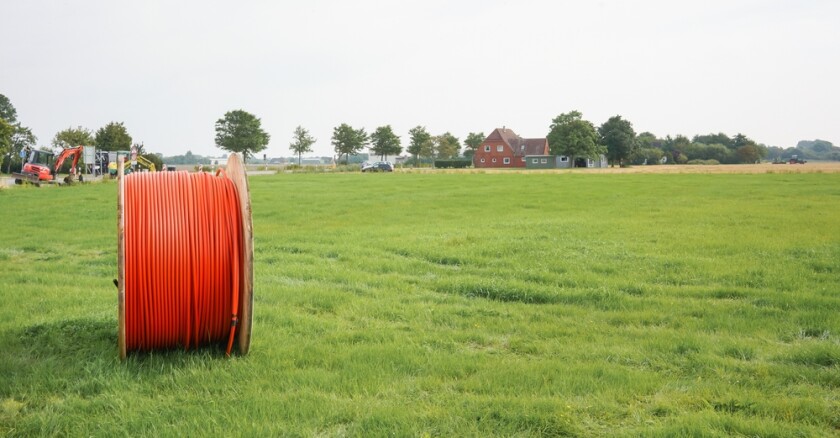
Folks were trekking to Lake Providence in the northeast corner of Louisiana from Washington, D.C., to cheer the expected expansion of high-speed Internet across the small city. The head of the state’s broadband office was set to attend. The Internet company, Conexon, had installed fiber optic cables in the ground, right up to the library, where the event was to be held.
But by the time of the event, in early May, the celebration and the exclamation point had disappeared from the poster. A few of the speakers had, too.
Instead, leaders were again answering the same question: Where’s the fiber Internet?
“We’re furious,” said Nathanael Wills, an organizer with Delta Interfaith, a coalition of congregations across the area. “We’re fed up.”
For five years, Delta Interfaith has been pushing to better connect this city, population 3,500, despite obstacle after obstacle. Among them: A cable company’s last-minute attempt to block a grant to build fiber in 2022. The Trump administration’s rewrite of the Broadband Equity Access and Deployment Program, known as BEAD, in 2025. The awarding of those dollars last year to satellite, rather than fiber.
But this spring, the community had been optimistic.
Though Conexon’s award for federal funding was rescinded, the Kansas City-based company was planning to extend fiber across the city on its own dime. With the help of a state grant known as GUMBO, it had already built fiber to homes outside of town.
Ahead of the May event, Conexon’s co-CEO Jonathan Chambers outlined his frustrations with the Louisiana’s Office of Broadband Development and Connectivity. But, he said, he had faith that the people of East Carroll “want for themselves and their children and their grandchildren something better than has been given to them,” he said. “I am building this on faith.”
A week beforehand, though, Chambers and the head of the broadband office, Veneeth Iyengar, disappeared from the event’s agenda.
Chambers says the state owes his company millions. Iyengar says the company needs to complete its work.
“Conexon has some additional homework,” Iyengar said. The state has reimbursed Conexon for 30% of its GUMBO project, he said, and has successfully audited 70% of the work. The process of reimbursement requires technical and compliance checks, he continued. “The last thing we want to do is a fund a program that does not comply with federal state and local rules.”
PROGRAM ‘HAS FAILED US HERE’
The dispute illustrates the complexities of mapping, funding and building high-speed fiber systems in the country’s most rural reaches. Now, Lake Providence residents are looking at whether they might build, own or run a network on their own.
“The BEAD program has failed us here,” Wills said.
After a prayer, Wills began the May meeting with “a major reality check.”
The $6.2 million in Broadband Equity, Access and Deployment funding awarded to Conexon was gone. Instead, funds went to SpaceX, which operates Starlink, a satellite-based service already available in Lake Providence.
Fiber cables, installed underground, consistently meet the Federal Communications Commission’s broadband requirements of 100 megabits per second for downloads and 20 Mbps for uploads. Last year, a national speed analysis found that just 17.4% of Starlink users got speeds consistent with those minimums.
But recently, satellite has improved: A May study by Ookla shows that in the second half of last year, 44.7% of Starlink users got those speeds.
“We set out a long time ago to build fiber,” Wills said, which is less expensive and more reliable. “We have not wavered.” So leaders were hopeful when Conexon said it would complete the network, crisscrossing through town, and disappointed when officials outlined their dispute.
“As it stands today, we are awaiting reimbursement from ConnectLA for two projects — our original build in East Carroll Parish, completed in 2024, and a recently completed build in Webster Parish,” a Conexon spokeswoman said by email. “Once we receive payment for those, construction will begin.”
Chambers compared working with ConnectLA to Charlie Brown attempting to kick Lucy’s football. But Iyengar disputed that characterization, saying that his office has been consistently applying a “sequence of steps to make sure the work is complete, compliant and fully paid out.”
The company received extensive funding from an earlier federal program for homes in the area. “We need to make sure we’re not … awarding funds to a location that has already received federal funds,” Iyengar said.
In the meantime, “we’re the community that gets caught in the middle,” Wills said.
At the meeting, attendees discussed another option: community control.
“Now I’m not going to kid you: It’s not cheap,” said Gigi Sohn, executive director of the American Association of Public Broadband. “But I just scribbled down a list of a dozen communities across the country that have decided — including Lafayette in Louisiana — to take their future into their own hands.”
Six years ago, Scott Woods, then a division chief at the National Telecommunications and Information Administration, worked with Delta Interfaith in its early days of fighting for broadband.
“This is personal to me,” he told the crowd of more than 40 residents. Delta Interfaith has been pushing for broadband in “the right way,” said Woods, now president of public-private partnerships for Ready.net.
“What's best for the community as a whole? Not just what's best for this side of the railroad tracks versus that side of the lake, but what's best for everyone together to move the community forward?”
Cassandra Toston grew up in Lake Providence, graduating from high school there. She would have stayed, too, but she couldn’t find enough work to support herself and her son. At 29, she left for Texas.
One day, decades later, her mother, Earnest Jean Overton Toston-Luster, a longtime cafeteria manager for the school system, called and asked how to make spaghetti.
“That was the most frightful phone call I have ever had in my life,” Toston said.
Soon after, doctors diagnosed her mother with dementia. Toston’s job with a sanitation company allows her to work remotely, anywhere in the continental U.S. She wanted to return home to Lake Providence, but the Internet was too spotty and too expensive.
So instead, she moved her mother to Texas with her. After a few years together there, she died in January 2025. “I feel like I let her down,” Toston said.
Then, at last, Conexon ran fiber lines to her childhood home in rural East Carroll. So, after 39 years away, Toston moved back in December. “That’s income that’s going into the community,” she said. In Texas, she paid $100 to $150 a month for solid Internet. Now, she’s paying “$67 and some change.”
“I’m loving it,” she said.
While working from the home where she grew up, Toston often glances at her fireplace. A portrait of her mother smiles back at her.
©2026 The Times-Picayune | The New Orleans Advocate, Distributed by Tribune Content Agency, LLC.









