
In the Southwest, one state is testing a device that shoots a small GPS-equipped dart that attaches itself to a suspect's vehicle during a high-speed pursuit. On the West Coast, a police department is using ear-mounted video cameras that capture an officers' view of traffic stops and other incidents. Police departments on the East Coast are using cameras on patrol cars to scan and track the license plates of each vehicle they pass, which lets them recoup overdue parking violations fines. It seems real life is catching up with science fiction.
Law enforcement technology may be evolving, but it hasn't changed the core responsibilities of police officers' jobs. Lt. Raymond Foster, author of the book Police Technology, said police officers still must talk to people and gather information. "Evidence is nothing but information," he said.
However, vast improvements have been made in detecting information, correlating it with databases, and exchanging data with others. "Technology has enabled us to find new information and new ways of organizing information to help us solve and prevent crimes," said Foster, a retired Los Angeles Police Department officer.
These innovations will keep citizens safer, and they offer an intriguing look at what the future holds for law enforcement technology.
Redefining Police Pursuits
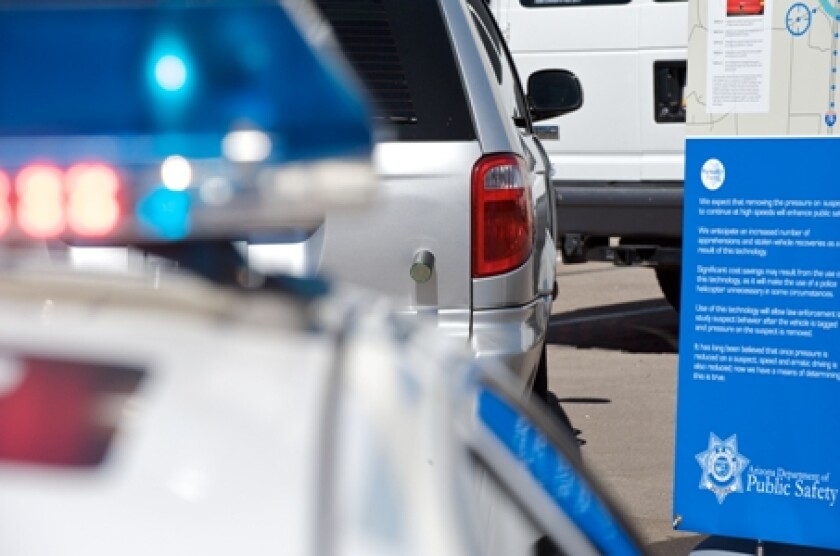
Policies for high-speed police pursuits vary among law enforcement departments, but all agree that car chases are dangerous. To help reduce the number of high-speed pursuits and the deadly collisions associated with them, last year the Arizona Department of Public Safety (DPS) began piloting the StarChase Pursuit Management System, which uses a patrol car's mounted launcher to shoot a GPS-equipped dart at a fleeing vehicle.
"It's a device that's mounted on the front of the patrol car, and there is a sighting device, targeting device and a deployment device inside the patrol car so the officer can adjust the aim depending on the type of vehicle," said Lt. Stephen Harrison, the department's public information officer.
Officers use a laser pointer to aim and then shoot the dart, which attaches itself to the suspect's vehicle. The dart includes a battery and wireless transmitter, allowing officers to track the vehicle's movement. "Dispatch is hooked into the device; they can actually monitor it on a computer screen with a map," Harrison said. "They can track where the vehicle is going, how fast it's going, if it's taking off-ramps or driving city streets."

Remote monitoring lets officers follow suspects from a safer distance so that suspects don't realize they're still being tracked. Dispatchers deploy officers around the suspect's location so that once the vehicle stops, officers can move in and detain him or her.
Harrison said the device has been used on stolen cars and human smuggling cases. "Particularly in human smuggling, we have an issue where the smugglers have no regard for human life, so they will speed away and quite often have a horrific collision, injuring and killing people - and then the driver flees," he said.
The pursuit management system costs about $4,500 per car. For tactical reasons, Harrison couldn't say how many patrol cars in Arizona have the system. But he said the devices are more cost-effective than having a helicopter follow a suspect's vehicle, which is a common practice nationwide.
The DPS found that in some instances, the system helps police avoid a high-speed chase altogether. Some violators will drive off as the officer is approaching the vehicle, so the officer will tag the vehicle with the device before the suspect can make a break for it, Harrison said. "The suspect doesn't even know they've been tagged, and we just let them drive off - they think they're free, but we are still following them," he said. "We've had great success with the system."
The one barrier the police department encountered was finding a place to install the system on the front of the patrol car where it wouldn't interfere with the siren and the vehicle's operation - the best location was the car's grille. Space also was needed inside the vehicle to house the targeting and deployment device, and with laptops, radios and other equipment running, room and electrical power can be maxed out in patrol cars. Harrison said it can come down to deciding to install the pursuit management system or another technology, like an in-car camera system, due to the limitation of the vehicle's electrical capability.
"High-speed pursuits are difficult; you don't know the driver's capabilities, the vehicle's capabilities," he said. "There is a significant safety factor in addition to a liability factor of chasing somebody at high speeds. ... We think it's an excellent tool to reduce the carnage associated with high-speed pursuits."
Freeze Frame
Dashboard cameras have become commonplace in patrol cars, but the San Jose (Calif.) Police Department is taking the technology to a new level - eye level. In December 2009, 18 officers began using the Axon head camera made by Taser International. As part of a free trial, the officers are testing the cameras, which rest on the officer's ear like a Bluetooth device, with a wrap-around head brace securing the HeadCam. The start/stop recording button rests on the officer's chest and also connects to the Axon Tactical Computer, a 4.3-inch touchscreen that attaches to an officer's belt and enables video playback.
"Our officers are always in the field and we're constantly being recorded," said Officer Jermaine Thomas. "So now you have it from an officer's point of view - what the officer is seeing and exactly what the subject or subjects have said in regard to any type of incident."
The department's policy requires that the officers activate the device anytime they're on a call for service or at an incident, Thomas said. San Jose's police officers have found that recording their interactions with the public can change the way they patrol. "It's a great mechanism because officers state that people do act different because they're being videotaped," he said.

At the end of a shift, the devices are returned to a docking station where the information
is downloaded to a server and the battery is recharged. Thomas said the recordings are stored for one year and can be retrieved for internal review or to show in court.
One drawback has been the bulkiness of the new wearable technology. However, Thomas said that in the future the technology will get smaller and easier to wear.
Foster, a Retired Los Angeles police officer, also worries that officers may tactically compromise themselves because they want to ensure that the camera is on before responding to an incident. "I hope that somebody doesn't think they should switch on their camera before they take the action they're supposed to take," he said.
Thomas said the device constantly stores video footage. When the officer hits the record button the camera has already recorded the previous 30 seconds, although it lacks audio. "When something happens, if the officer doesn't have time to [turn it on], if he's in a high-risk situation he's going to have to deal with that first," he said. "But once it's over, you can tap the button and it actually records 30 seconds before you turn it on."

The New Ride-Along Partner
As the recession continues to batter state and local government budgets, the nation is looking for inventive and cost-effective methods to recoup funds. Although license plate recognition systems have been used in the United Kingdom since the '90s and became popular in the U.S. during the last decade for spotting stolen vehicles, at least one locality is repurposing them to help collect the $1 million owed to its parking violations department.The Greenwich (Conn.) Police Department outfitted two patrol cars with a device that can scan up to 3,600 license plates per minute while officers drive on patrol. The automated license plate recognition system, Elsag North America's Mobile Plate Hunter-900, uses two cameras attached to the patrol car, one on the left side and one on the right. "They're angled and have wide lenses so they'll capture the license plates of cars approaching as well as cars that are parked on the sides," said Greenwich Police Sgt. John Slusarz.
Officers manually upload three lists into the system: one from the local Parking Violations Office that includes the town's parking ticket scofflaws; a list from the Connecticut Department of Motor Vehicles of expired, canceled and suspended license plates; and one from the FBI's National Crime Information Center of wanted people.
The cameras are linked to software that runs in the background on the officers' laptops. While they're on patrol or responding to a call, the system scans all license plates the car passes. "If it finds one that's on one of the lists, it will advise the operator that it just located one of the plates and what it's on the list for - whether it's a stolen car, unregistered or has suspended registration, or whether it's a scofflaw violator," Slusarz said. The software also shows a photo of the vehicle and says which side of the patrol car it was on.
"For a patrolman, collecting fines for parking violations isn't the top priority, so if he's going to a call and the system says scofflaw violator, that's the last thing on the list for him," he said. "But if he's on routine patrol and goes by a scofflaw violator, then his practice is to stop and call Parking Violations to make sure it hasn't been paid since the system was last updated." A parking violations employee puts a boot on the vehicle, which is removed after the individual pays the fine.
Although it cost about $40,000 to outfit the two patrol
cars with the technology in October 2009, two months later about $5,000 in outstanding parking fines had been collected using the system. Slusarz estimated that the system would continue locating about $2,500 per month in overdue fines -money that will aid local agencies during the tough economy.
Another benefit of the system is that it records the license plate number and GPS coordinates of vehicles it scans, which is especially useful when an officer is responding to a call. Slusarz said officers manually track the license plates of vehicles near a crime scene, but the system completes that task automatically. Officers also use the system to search for a specific plate, like one driven by a burglary suspect, to determine if the car has been in the area before. "It's used as an investigative tool as well, which is very good," he said.
In the future, the police department wants to purchase surveillance-type license plate readers that will attach to telephone poles. Slusarz said there are many vehicle thefts in the spring and summer, and the technology will help to track the vehicles. The patrol car-based system is also used by nearby police departments in Stamford and Norwalk, and the towns are interested in creating a regional fusion center to share information.
"All the cars that are collecting this data will be able to extend the data to this one centralized location," he said. "That way, officers who are doing their investigations and are looking for particular cars and patterns with these cars can log in to the center and be able to see and track patterns."
These new technologies highlight merely a few examples of how technology has changed and evolved to aid law enforcement officers. As for the future, the possibilities seem endless.









