-
 After transitioning from Fairfield University’s leader of enterprise systems to director of IT strategy and enterprise architecture for the state of Connecticut, Armstrong will return to higher-ed leadership in January.
 -
To prevent students from relying on artificial intelligence to write and do homework for them, many professors are returning to pre-technology assessments and having students finish essays in class.
-
A new online course aims to train instructors on how to incorporate a growth mindset into existing teaching practices, as it can positively impact student experience and outcomes.


More Stories
-
Students and faculty from the University of Texas at San Antonio have worked with local school districts to provide technology, lessons and other resources to K-12 students regarding IT career opportunities.
-
The Campus Reimagined initiative at Florida State University has attempted to combine pedagogical best practices with simple tech tools to maximize student engagement whether they’re learning remotely or in person.
-
As the university develops new courses and degree programs in AI, new professors will teach its implications in 20 departments including epidemiology, social welfare, psychology, statistics and digital forensics.
-
College and university IT departments are busier than ever accommodating the shift to hybrid learning models, putting pressure on CISOs and their staff to strengthen cybersecurity without ballooning costs.
-
The Digital Footprints Project at West Virginia University shows the potential for institutional data about student engagement, performance and other metrics to enable early intervention strategies.
-
Following the addition of 11 classrooms to its Phillipsburg campus, a New Jersey community college has dedicated labs for GIS, photogrammetry, maintenance and repair, building and teaching people how to fly drones.
-
A federal grant through the Connecting Minority Communities Program will allow ASU to purchase devices, educational software, Internet access services, and other IT software and hardware for low-income students.
-
Building upon its collaboration with industry partner Enterprise Holdings Foundation, the Southern Illinois University Edwardsville's new facility includes state-of-the-art industry tools for engineers.
-
A public technical school in South Dakota will revamp its radiologic tech program with state-of-the-art equipment and an improved lab space thanks to a donation from a regional health system.
-
With progress in cloud computing and adoption all but certain to continue for the foreseeable future, IT leaders in higher education should keep a weather eye on their options, spending, data silos and security posture.
-
Expecting its first group of graduates in spring 2024, a new bachelor of science in engineering technology program at Ohio State University at Lima could improve the talent pipeline for area manufacturers.
-
Educators from Stanford University shared lessons from their campus’ overall experiences with remote learning, including student struggles and academic innovations, at the virtual Educause Annual Conference last week.
-
At an annual State of the College event, El Camino College President Brenda Thames emphasized investments and programs to prepare students for evolving fields in computer science, environmental tech and cybersecurity.
-
Internet services are down across Riverland Community College's three campuses in Minnesota, and the college says it's working with Minnesota State system office technology personnel, Microsoft and Dell to resolve it.
-
At a Thursday webinar panel for the Educause Annual Conference, former U.S. Secretary of Education and Chicago schools CEO Arne Duncan described technology access and degree completion as major issues facing higher ed.
-
A grant from the U.S. Department of Commerce's Connecting Minority Communities Program will allow the southwest Georgia university to improve its broadband infrastructure and hire and train IT personnel.
-
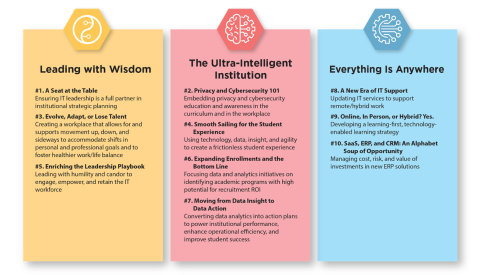
Making sure CIOs have a seat at the leadership table and reducing staff turnover are both key IT challenges in higher education today, according to the ed-tech advocacy organization Educause at its annual conference.
-
Year-over-year data suggests students are becoming more comfortable with, and optimistic about, online learning, while educators and institutions are advised to track student outcomes after implementing new technology.