
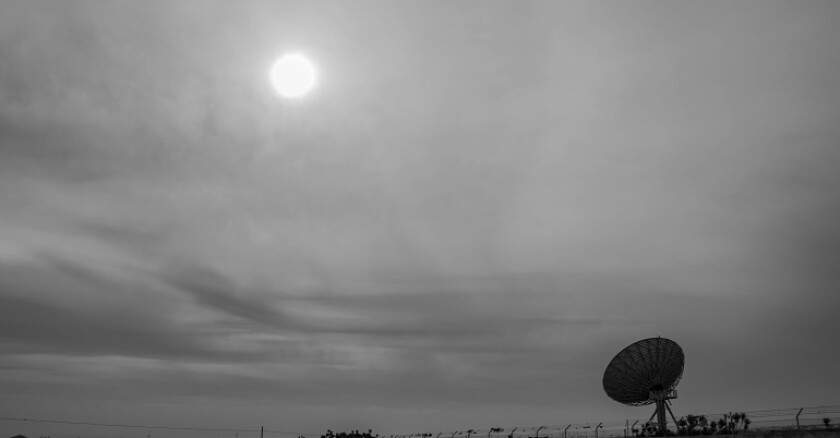
While space elevators and colonies on the moon are still squarely in the realm of science fiction, developed countries like the United States heavily utilize satellites, so-called space infrastructure, to facilitate and support communication functions, entertainment systems, weather forecasting, search-and-rescue functions, global positioning systems and national defense elements.
As of 2015, there were more than 1,000 active government and private satellites in space with an additional 2,600 devices that no longer function. These nearly 3,700 items range in size from a few pounds to as big as a school bus. More than 15 countries and hundreds of private companies own these satellites. Of the active satellites, there are 502 active American, 188 Russian and 116 Chinese.
These man-made objects are not the only things in space. In fact, the United States Surveillance Network estimates that there are more than 21,000 objects larger than 10 centimeters (about 25 inches) orbiting the Earth, with an additional 500,000 smaller pieces. All natural and man-made space objects travel at extraordinary speeds even if they are geospatially maintained in many cases. As these items continue to increase in number and interaction, there is a risk to the critical infrastructure systems discussed earlier that are maintained through the multitude of satellites.
Modern society relies on the constant functioning of the critical infrastructure to provide for public health and safety, maintain crucial government responsibilities, improve economic well-being and to guard the overall health of a nation-state. Examples of existing infrastructure include a nation’s power grid, potable water supply and communication systems.
Any interruption or failure of any one of these systems can result in the cascading loss of other critical infrastructure systems (a loss of power can lead to a loss of water and communication) and can have a devastating effect on the population. Many of these critical infrastructure systems are already incorporated as sectors in the United States Department of Homeland Security’s (DHS) National Infrastructure Protection Plan (NIPP).
Specifically, the NIPP lists 16 sectors ranging from communications and energy to financial services and information technologies. However, no sector exclusively addresses the space-based systems that are responsible for a variety of functions that have become essential in American society. Instead, these space components are incorporated into various other related sectors, such as communications and national defense.
However, these space systems are used daily by a large percentage of the population for uses such as television, Internet, and GPS. Other systems exist in space that are crucial for national security as well, while others are for essential aspects of the economy, and those also elements that are there for the advancement of mankind’s knowledge of both our own planet and the universe. These critical systems and their vulnerabilities need to be addressed by the DHS and incorporated into the NIPP.
What Is Space Infrastructure?
Over the last 60 years, space systems have evolved from a single Soviet satellite to a vast network of satellites and space stations, and as our exploration of space continues to expand there is now the possibility of establishing infrastructure on extraterrestrial bodies. According to the International Academy of Astronautics, space infrastructure is unique in the fact that there are three components: space-based, ground-based and administrative. Space-based components cover the satellites, probes, telescopes, space stations, etc., while ground-based elements are the launch facilities and the technologies to operate, analyze and maintain the space-based infrastructure.The administrative portion is the policy, politics, regulation, and other national or international communities that shape the field of space. Not all of this space infrastructure should be considered critical, just as not all energy or financial services technologies are considered critical infrastructure. The critical space infrastructure label should be limited to the major technologies, operations and networks that are vital for functioning, interaction and interdependency with the other critical infrastructure sectors and daily operations of society.
Threats to Space Infrastructure
Space infrastructure faces a multitude of threats and hazards, some that are similar to other infrastructure sectors, but others that are unique. These risks can come from either naturally occurring phenomenon or from human activity. For example, meteor showers can cause damage to satellite systems as the comet dust blasts the mirrors, lenses and optics of the satellite.Although rare, even direct impact is a threat, such as the case in 1993 when the Perseid meteor shower took out the Olympus-1 satellite, which was the largest civilian telecommunication satellite ever built.
Additionally, satellites are under a constant barrage of radiation but can be heavily damaged from coronal mass ejection from the sun, which creates geomagnetic storms that can directly damage satellites or even modify their orbit by temporarily increasing upper-atmosphere density and temperature. This means that after every major solar storm, NORAD and other space-related agencies have to re-identify and calculate the new orbits of hundreds of satellites, probes and other spacecraft. It is a major challenge to have to keep track of all these satellites to prevent collisions with debris, space junk, or other satellites.
Additionally, the amount of space debris has been rapidly increasing at an alarming rate over the past decade, partially due to recent incidents. Specifically, in 2007, China conducted an anti-satellite missile test, which created more than 35,000 pieces of space debris larger than 1 centimeter. This event represented the single largest historical increase in the presence and distribution of space debris. According to the NASA Orbital Debris Program Office, a large amount of the debris from the 2007 event will still be in orbit for decades or centuries to come.
Ground Risk
Operational satellites not only pose a space debris risk, but depending on their power and fuel systems, they can also pose a risk to those on the ground. For example, in 1978 a Soviet reconnaissance satellite with an onboard nuclear reactor failed, and during reentry spread radioactive material over much of northern Canada.Many satellites have nuclear reactors and will remain in orbit for long periods. Others contain large amounts of hazardous materials such as hydrazine, which is the most commonly used propellant fuel for rockets and is highly toxic and corrosive, as well as a carcinogen, and beryllium, which is widely used in computers, heat shields and electrical components but is also a carcinogen and can cause fatal respiratory diseases from inhalation of its fumes or particles. Consequently, the operational systems of both active and inactive satellites may continue to be a risk to the health, safety and protection of assets on the ground for a long time to come.
Human-Caused Threats
Although these threats are mainly accidental or naturally caused, there does exist the possibility of a hostile threat from other nations and non-state actors. Although missiles have previously destroyed satellites, there are many other ways they can be attacked, including using ground-based lasers to blind optical sensors on photoreconnaissance satellites, creating fake GPS signals that overpower the real ones (which could heavily disrupt the many other critical infrastructure sectors that rely on GPS signals), or even cyberattacks on satellites to steal or manipulate data. These attacks can come from a variety of sources and can target systems both on the ground and in space.As vulnerable as the government space infrastructure is to a cyberattack, the civilian hardware is even more susceptible, as there are no standard security requirements. Though no documented cases of this type of action have occurred, the possibility and relevance are real and must be considered fully when evaluating the full spectrum of space infrastructure.
Space Mining
Even as our existing systems become more reliant on space infrastructure, new kinds of space infrastructure are already appearing. Privately funded companies such as SpaceX are now able to launch spacecraft into orbit and are taking a more prominent role in delivering space systems.There are now serious planning efforts about possible manned missions to Mars by both government agencies and private companies, and a whole new industry is in the process of being formed around the concept of asteroid mining. This has attracted the interest of NASA, as well as spurred the creation of venture capital companies due to asteroids containing industrial and precious metals that potentially could be worth trillions of dollars.
As the amount of space infrastructure continues to grow, and as more private companies become involved, there needs to be a concentrated focus on securing this infrastructure. Incorporating space systems into their own sector in NIPP would be a significant step forward in decreasing their risk. Each critical infrastructure sector has its own Sector-Specific Agency, which is responsible for developing and executing a sector-specific plan and identifying vulnerabilities and helping mitigate incidents. Due to space infrastructure overlapping many different agencies and having a variety of responsibilities, it may be difficult to assign an individual agency, although DHS and U.S. Department of Defense are potential candidates.
Establishing a defined and basic set of cybersecurity standards for both government and the private sector is also desirable, but there is a fine line — the standards cannot be too lax or they may become outdated and vulnerable, but also cannot be too restrictive and risk limiting communication, functionality and innovation. Ultimately, the protection and preservation of space infrastructure of all forms is critical to the maintenance and quality of life in developed countries and should be better addressed in formalized planning and management.







