
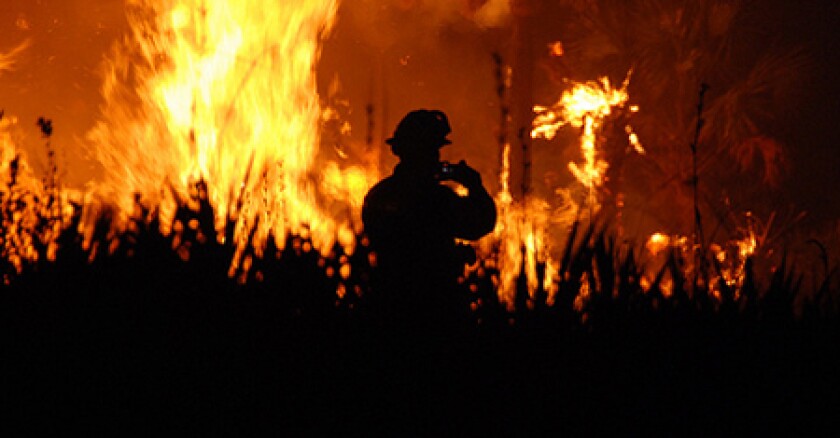
FEMA has reduced the payments that local fire departments receive for the use of their equipment, namely fire engines, when they're asked to help with wildfires outside their jurisdiction.
The new reimbursement rates, firefighters say, don't cover their costs. This not only short-changes hundreds of city and small-town fire departments, many of which operate on shoestring budgets with volunteer staffs, but could prompt some departments to stop answering calls for help.
California and other western states rely on a system of mutual aid for wildfire response. Under the system, agencies step up to assist one another in putting out blazes that no single agency could handle alone.
"We shouldn't be doing anything that discourages local-government fire chiefs from helping their neighbors during fire season," said Mark Lorenzen, fire chief for the Menlo Park Fire Protection District, which serves Menlo Park, Atherton and East Palo Alto and participates in California's mutual aid system. "But our engines are expensive and the methodology that FEMA is using doesn't come close to reimbursing us for what the actual cost is. ... Certainly, if you get a financial haircut on reimbursement, that doesn't help you with your decision" to send help.
The mutual aid system in several states, including California, is already under strain. The uptick in wildfires over the past two decades has left many fire departments sometimes reluctant to deploy crews elsewhere for fear of a local ignition or burdening their staff with extra work.
FEMA officials say the new reimbursement rates simply reflect changes in cost and market conditions.
In the case of vehicles, the agency cites lower fuel prices and increasing fuel efficiency for driving down expenses and hence payouts. The agency also notes that some vehicles have transitioned from diesel to less expensive gasoline.
Many fire departments, however, say overall vehicle costs have been rising.
The cuts to reimbursement come as President Donald Trump's administration pursues a broader agenda of tightening the federal government. At FEMA, which the president has said is inefficient and needs restructuring, the administration has trimmed the workforce, reduced grants for emergency preparedness and delayed responses for disaster aid. More than a year after the deadly wildfires in Los Angeles, the federal government has not responded to Gov. Gavin Newsom's plea for additional money to help rebuild.
The reimbursement rates for equipment, which are generally adjusted every two years, are set by FEMA but usually paid out by the agency that requested assistance from a local fire department, such as the U.S. Forest Service or Bureau of Land Management.
Local fire departments also receive reimbursement for personnel costs under the mutual aid system, but those payments are based on a different set of calculations and haven't been reduced.
While the new rate schedule for equipment took effect late last year, most fire departments are yet to be impacted because the changes came after peak fire season. The rates cover hundreds of items, from chainsaws to generators to drones. In some cases, the payouts have risen, but for fire engines, which are commonly called upon and particularly pricey to operate and maintain, the rates have dropped.
For example, reimbursement for an off-road fire truck used for battling wildfires, known as a type 3 engine, is down 42%, from $156.74 an hour to $90.66 an hour.
Damon Carrington, fire chief at Big Pine Fire Protection District in rural Inyo County, has already started calculating the losses he expects this year if he sends his volunteer firefighters out of the area. Applying the new reimbursement rates for equipment to his small agency's nine deployments last year, he would have received $160,000 less money. The district's base fire budget annually is only about $330,000.
"That's (the loss) just to my department," he said. "I don't know what that's going to mean for Sacramento or San Francisco. But it's going to be a huge loss to all the departments."
Carrington said he has been thinking about whether his agency will continue to provide as much fire assistance as they have in the past. The wear and tear on an engine, some of which can cost more than $1 million, can be a significant toll.
" Big Pine will still do mutual aid in Inyo and Mono counties," Carrington said. "But going to San Bernardino County or up to the Northern California counties, we will give it one or two times to see what it's doing to our equipment. If it's not working out, we probably won't go."
In California, $75 million exchanged hands for equipment reimbursement last year, according to the Governor's Office of Emergency Services, which oversees the transfers. The reimbursement amount fluctuates with the severity of the fire season, but state officials say they expect payouts will drop disproportionately going forward.
"The new FEMA rates are out of alignment with actual costs in California," Cal OES said in a statement to the Chronicle. "Cal OES is moving with urgency by engaging with FEMA and California fire agencies to develop a California -specific equipment rate structure that is more realistic."
FEMA officials have not said publicly whether they're considering amending the rate schedule.
The state of California also uses FEMA's rates to reimburse local fire departments for equipment when Cal OES and Cal Fire request help.
Inyo County Supervisor Jennifer Roeser is among those urging FEMA to make changes.
"I get that the federal government is trying to reduce spending, but this is not a good way to do it," she said.
Roeser said that sparsely populated counties like hers, which lack the tax base of some of their larger peers, don't have big enough budgets to absorb losses that may come with sending out local crews. Inyo County has six fire departments, all of which are staffed by volunteers.
Roeser also worries that fire agencies outside her county may not send help to Inyo County if they're not getting reimbursed adequately.
"The West is just too big and too broad to leave these little departments dangling," she said. "We need to get this fixed as soon as possible."
©2026 the San Francisco Chronicle. Distributed by Tribune Content Agency, LLC.







