

- Will AI Executive Order Impact BEAD?
- Arizona Launches Permit Finder
- Legislation to Speed Broadband Deployment
- New Mexico Connects Students
- Officials Declare Seattle’s Tech Drive a Success
WILL AI EXECUTIVE ORDER IMPACT BEAD?
A draft presidential executive order would, if issued, take action to eliminate state laws on AI, limiting state-level regulatory authority. Notably, this order as written would impact the Broadband Equity, Access and Deployment (BEAD) program’s nondeployment funds.
The BEAD program’s rules changed earlier this year, impacting states’ progress on the 10-year initiative Congress passed as part of the Bipartisan Infrastructure Law. Since then, Congressmembers have been calling for clarity on how non-deployment funds can be used.
The June 6 BEAD Restructuring Policy Notice said that the future of nondeployment funding “is under review.” In an Oct. 28 speech, Assistant U.S. Secretary of Commerce and National Telecommunications and Information Administration (NTIA) Administrator Arielle Roth said final decisions on how these funds could be used had not yet been made. One U.S. representative issued a statement saying treating non-deployment funds as optional is “ignorant.”
The BEAD Program’s progress has been delayed due to changes, and some experts have criticized the shift to infuse a nonpartisan program with partisan issues.
“Rather than doing the hard work of establishing a federal regulatory standard for AI with Congress, the White House has invented authorities and delegated non-existent powers to the agencies and executives most anxious to do the President’s bidding,” senior policy advocate at the nonprofit organization Public Knowledge Nat Purser said in a statement, noting that the organization finds the proposed executive order to be illegal.
In a letter to Roth, Joe Kane, director of broadband and spectrum policy at the Information Technology and Innovation Foundation, emphasized that “the digital divide has both deployment and nondeployment components.”
Some officials have criticized delays to the BEAD program caused by the new administration, including U.S. Rep. Troy A. Carter Sr. He issued a statement after Louisiana’s second approval for BEAD funding and criticized actions by the U.S. Department of Commerce that withheld funding and delayed action, saying the program changes have upended “years of planning” and forced states to start over.
Lawmakers and members of the public have voiced opposition to challenges or limitations on state lawmaking authority for AI.
ARIZONA LAUNCHES PERMIT FINDER
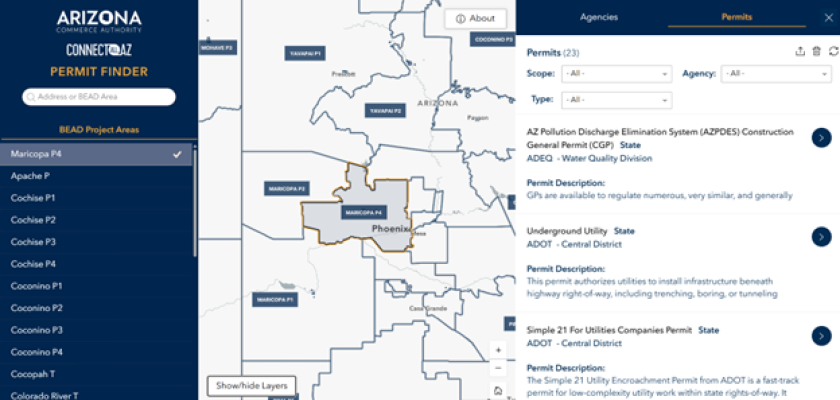
The Arizona State Broadband Office launched an interactive permitting map, to support broadband expansion by reducing regulatory barriers.
The Arizona Permit Finder consolidates permitting requirements into one centralized resource to ensure that stakeholders — primarily Internet service providers and subgrant recipients for BEAD program funding — have access to the agency and contact information they need to support their work.
“Permitting-related delays continue to be one of the most significant barriers to connecting unserved communities,” Roth said in a statement. “We commend the Arizona Commerce Authority for their work to tackle this challenge.”
The new tool aims to help users more easily identify broadband deployment projects that may require permits or cross-agency considerations. However, it is intended for informational purposes only, and it is not exhaustive; as such, it should not be perceived to replace statutory, regulatory and other requirements set forth by NTIA.
LEGISLATION TO SPEED BROADBAND DEPLOYMENT
In other federal news, U.S. senators introduced bipartisan legislation last week that seeks to make the deployment of telecommunications and broadband equipment more efficient.
The Broadband and Telecommunications RAIL Act would establish two separate processes to support deployment in public and railroad rights of way. First, broadband providers would work with the state or locality to determine the scope of authorized work, notify the rail carrier, and schedule the work. Second, providers would be required to request permission before putting their equipment in rights of way owned by railroad carriers. The rail carrier may only deny such requests if safety, damage or operational requirements are not met.
NEW MEXICO CONNECTS STUDENTS
In state news, the New Mexico Office of Broadband Access and Expansion (OBAE) is continuing to expand access to the Internet for state residents.
Last week, OBAE announced that Las Vegas City Schools, a district in New Mexico, connected all five of its schools to the state’s new broadband education network. The Statewide Education Network launched in July 2024 to provide high-speed Internet and to support schools’ sharing of information and resources. Network access is now available to 222 schools and sites.
In addition, OBAE announced that a $1.5 million Student Connect grant has been awarded to Transworld Network LLC to provide high-speed Internet to rural students in the Lordsburg Municipal Schools District.
The award comes from OBAE’s Connect New Mexico Fund, established by the Connect New Mexico Act in 2021.
OFFICIALS DECLARE SEATTLE’S TECH DRIVE A SUCCESS
In local news, Seattle’s IT Department blog, Tech Talk, declared its Old Tech Drive a “smashing success.”
Held Oct. 7-8 in partnership with PCs for People, the Old Tech Drive encouraged people to responsibly and safely dispose of old technology. Through this event, the city was able to collect 44 laptops, 36 tablets, 60 phones, four desktops and five monitors. Notably, 705 pounds of e-waste were successfully diverted from landfills and 825 pounds of CO2 emissions were prevented, per the blog.
The collected items will either be refurbished to help those in need or recycled in an environmentally friendly way. The city plans to host another such event in early 2026.










