
-
 Educators moved quickly in the pandemic era to scale access to virtual learning — but governance, accountability and data systems have not kept pace. A patchwork of models and standards complicates solutions.
 -
In light of staffing shortages and budget cuts, California State University, Los Angeles, is contracting with the software company Terra Dotta for tools and services to handle federal immigration reporting.
-
Student interns at the nonprofit xSpring got hands-on research experience while helping develop a “virtual neurologist” that could speed stroke diagnosis and expand access to lifesaving treatment.


More Stories
-
The new Center for Leadership, Institutional Metrics and Best Practices run by the nonprofit Complete College America will give colleges tools to track predictors of success and incorporate them into strategic planning.
-
The Meritocracy Fellowship program at Palantir, a controversial tech company owned by Peter Thiel, offers an internship in place of traditional higher education. Students see both advantages and disadvantages.
-
The State Bar has petitioned the court to adjust hundreds of test scores due to technical problems, and the court is demanding answers from the State Bar about how and why it used AI to develop exam questions.
-
The State Bar of California stirred some controversy when it disclosed that some questions on this year's exam were developed with the assistance of AI by ACS Ventures, the State Bar's independent psychometrician.
-
Money from the Oregon CHIPS Act, a package of legislation from 2023, will help Oregon colleges and universities hire artificial intelligence faculty and technical experts.
-
The university's pilot program, which will use virtual teaching assistants to explain course concepts to students and guide them through problems, will contribute to a study on virtual TAs working across 26 campuses.
-
More than one million American women were working in STEM occupations in 2023, only representing 26 percent of the STEM workforce, according to a networking organization. In 2016, they were 21 percent.
-
In the face of stress and uncertainty around the future of higher education, the CIO of a community college in Oregon suggests a CARES framework of priorities: communicate, adapt, relationships, empower and stay calm.
-
The first associate's degree program of its kind at a community college in Alabama prepares students for careers in AutoCAD design, surveying and construction applications. It's also open to dual-enrolled high schoolers.
-
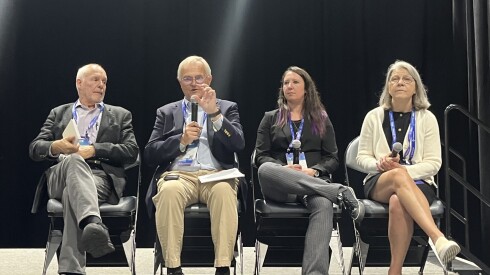
At the ASU+GSV AI Show, a former IES leader and those who have benefitted from its work discussed the value of education research and what to focus on when rebuilding ed-tech research systems.
-
A joint venture between several universities, the Massachusetts Green High Performance Computing Center is building computing capacity with investments expected to top $100 million over the next five years.
-
In a five-year partnership with the biomedical research company Leidos Inc., the university will develop artificial intelligence-powered tools to diagnose and treat ailments such as heart disease and cancer.
-
The vice president for digital innovation at the American Association of Colleges and Universities says AI discussions and assignments are essential for preparing students to be competitive in the working world.
-
Through internships with the Lackawanna County district attorney’s office, university students will work with detectives to extract and analyze cellphone data related to criminal cases.
-
The state's Legislative Audit Council says USC misused $4,589 in grant money intended for computer labs, while the university says those watches are part of teaching and understanding Apple's technology ecosystem.
-
Leaders from across the political spectrum found common ground at the ASU+GSV Summit in San Diego this month discussing workforce preparation and critical thinking, which all parties seem to agree need attention.
-
An informative event last week hosted attendees from law enforcement, the judicial system, private businesses and educational institutions such as Troy University, Wallace Community College and local high schools.
-
Now more than ever, higher education and its advocates need to clearly and publicly explain what it means for the U.S. to train and attract generations of experts in competitive STEM fields — or to lose them.




Most Read

- Yuma County, Ariz.’s New CIO Hails From the City of Yuma
- Funding California IT Like Other Types of Infrastructure
- Is there a bike bell that you can hear even with noise-canceling headphones?
- Casper, Wyo., Will Use AI to Analyze Police Bodycam Footage
- Oakland County, Mich., Approves Drone Pact Despite Opposition







