
-
 As artificial intelligence and digital tools continually reshape their coursework, students say common frustrations include a lack of clear AI guidance, an overabundance of tools and apps, and Wi-Fi connectivity issues.
 -
A multiyear initiative between a private historically Black liberal arts college and a tech company will expose up to 750 high school students in the Birmingham area to AI technology and workforce opportunities.
-
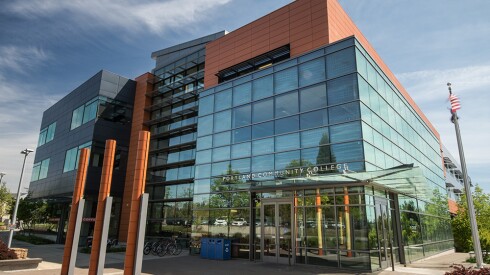
A new facility at Portland Community College is helping students practice specialized manufacturing skills and cleanroom protocols using equipment that simulates a real manufacturing environment.


More Stories
-
Higher education is uniquely vulnerable to cybersecurity attacks, presenters at one EDUCAUSE Annual Conference session said, and institutions should work together to address their vulnerabilities. Training and awareness are vital.
-
Given the rate of student and staff turnover, not to mention synthetic identities and fraud by "ghost students," identity and access management is a challenging but essential aspect of an institution's cybersecurity.
-
The Cybersecurity Research and Outreach Center at Emporia State donated a pair of computers to the local senior center, and ESU students will provide monthly classes on topics such as scams and basic computer skills.
-
Assistant art professor Josias Figueirido created an exhibit where visitors can use their smartphones to enable a virtual-reality experience by scanning a QR code and watching characters travel through a room.
-
A new Center for Artificial Intelligence and Emerging Technologies at Pennsylvania Western University will provide tools, knowledge and training for faculty to integrate AI effectively into their teaching.
-
In a Q&A with The Advocate, the dean of the business school at Loyola University New Orleans says the next generation of business leaders will need to know how to do AI-infused analytics and use the most recent tools.
-
A Ph.D. student at Columbia University created Curiously, a tool for teachers to build and customize AI assistants for their particular subjects and classroom needs, even if they have no coding expertise.
-
In addition to teaching students and professionals about the drone industry, Sinclair Community College in Ohio does consulting and research for equipment manufacturers in France, Switzerland, the UK and elsewhere.
-
In visiting the Universities at Albany and Buffalo last week, New York Gov. Kathy Hochul said they are integral to the state's plans, "like a heart beating in a body, pumping technology and future through its veins."
-
The Empire AI Consortium, which consists of public and private universities led by the University at Buffalo, is launching this fall to help researchers study problems from cybersecurity threats to hurricane preparation.
-
Southern Maine Community College's class on EV repairs launched in 2021, teaching students to perform predictive maintenance, diagnose and repair hybrid and electric vehicles, and pass a national certification test.
-
The American Association of Colleges and Universities recruited 124 institutions to participate in its Institute on AI, Pedagogy, and the Curriculum, an online program to help educators incorporate AI into their courses.
-
The university intends to buy all of its energy from renewable sources by 2030 and achieve “net-zero” status by 2040 using solar arrays, electric buses, composting, renovations and new construction rules.
-
Wednesday afternoon events at Colorado State University's Northeast Colorado Engagement Center in Sterling will explain how recent breakthroughs in artificial intelligence can empower bad actors to deceive voters.
-
Researchers at Stanford University are designing Clinical Mind AI to be a customizable chatbot that can function as a virtual patient with which medical students can interact and practice forming diagnoses.
-
From generating research questions to analyzing data to running simulations, AI could affect every aspect of the scientific process, but experts say accuracy and sustainability should be part of the conversation.
-
Nvidia will work with Carnegie Mellon University and the University of Pittsburgh to make Pittsburgh the company's first "AI Tech Community," with joint technology centers focusing on robotics and health sciences.
-
The university's new facility includes dedicated lab space for designing and building satellites, a digital engineering lab, and a nanofoundry to develop new materials for satellite construction and quantum computing.









