

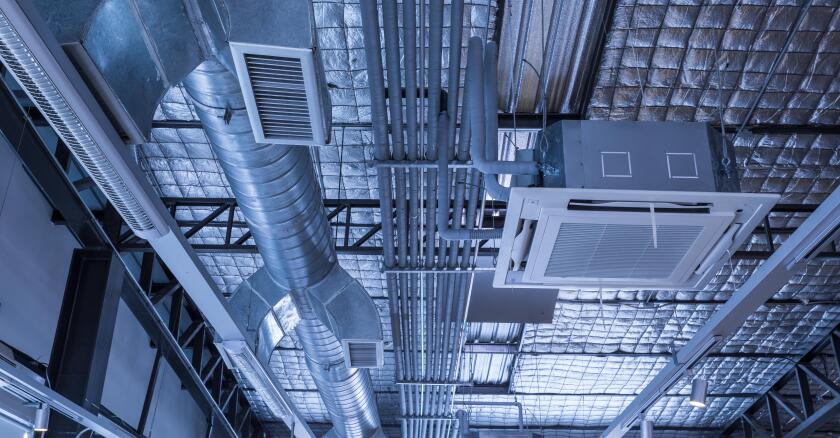
By giving AI control over heating, air conditioning, ventilation, window shades and other key operations of the building, researchers hope to improve the performance of commercial buildings and thereby reduce carbon emissions. Buildings as a whole are responsible for over 35 percent of the United States' carbon emissions.
The research team that includes Iason Konstantzos and Xiaoqi “Clare” Liu, who are both assistant professors at UNL’s Durham School of Architectural Engineering and Construction — as well as Dung Tran, a former UNL researcher who's now at the University of Florida — received a $1.2 million, three-year grant from the National Science Foundation to develop an AI algorithm that can control a building’s environment and strike a balance between energy efficiency and comfort without human input.
The research project will be conducted in a laboratory in a 1,000-square-foot building at the Peter Kiewit Institute, which is located on UNO’s Scott Campus. Konstantzos described the building as already having “state-of-the-art” HVAC, lighting and shading systems.
“This is a building that’s very rare,” he said. “I think there are less than 10 of these in the entire country that can modulate the entire environment to the extent that we can.”
Right now in modern society, Konstantzos said, there’s usually an imbalance between efficient energy use and people’s comfort.
“Typically the more comfortable we are, the more we need systems to support that,” he said. “If we are very comfortable, we consume more energy and vice versa.”
COMMERCIAL BUILDINGS ARE FOCUS OF RESEARCH
The lab will simulate a commercial building environment with open spaces, which Konstantzos said are more conducive for AI environmental control.
In a typical home, Konstantzos said, “the systems we have are much less flexible in terms of how we can control them.”
“This AI component of what we are doing requires computational loads like calculations that we have the privilege in the university to have supercomputers working for us,” he added.
If AI can indeed successfully control a commercial building’s environment, then it creates a foundation for applications to residential structures.
In order for the AI experiment to be successful, Konstantzos said the automated system must foster comfortable conditions so people don’t feel the urge to override the system.
To gain building occupants’ trust in the efficacy of AI, the researchers plan to present a user interface that can show the efficiencies in real time.
“We want to find the best way to digitally present that,” Liu said.
In addition to regulating the lab's temperature, lighting and windows, the AI algorithm, via sensors, will also seek to capture data from building occupants, including measuring physiological functions like heart rate and skin temperature. Based on those readings, the algorithm will be able to automatically adjust building systems to achieve desired comfort and efficiency.
By the end of the grant-funded period, Liu said researchers hope to have an AI prototype implemented in the Kiewit Institute lab and have the methodology ready for the algorithm to be implemented in other commercial buildings. Liu acknowledged that, if and when the AI system is deployed in other buildings, there will be new challenges to solve.
“We do want to continue this line of work beyond the duration of the project,” she said.
© 2026 Omaha World-Herald, Neb. Distributed by Tribune Content Agency, LLC.









