

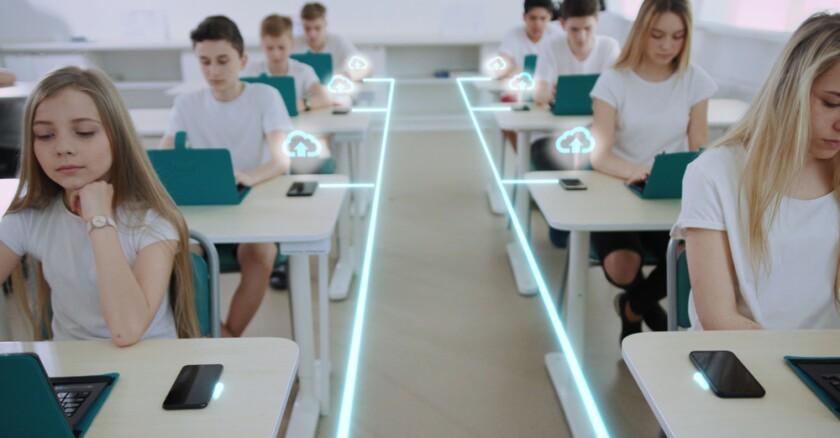
The programs aren't entirely a recent development. Since the late 1990s, U.S. school districts have been experimenting with giving each student a laptop or personal device (1:1) so they could learn anywhere. However, during the COVID-19 pandemic, 1:1 programs expanded significantly as schools transitioned to remote instruction, according to Keith Krueger, CEO of the ed-tech professional association Consortium for School Networking (CoSN).
"Since the pandemic, we’ve seen a tremendous increase in the number of classrooms that are 1:1,” he said. “High school and middle school are basically at about 90 percent of classrooms having a 1:1 environment. Grades three to five are at about 86 percent, and even at the [kindergarten through second-grade] level, we see a pretty high level of 76 percent.”
According to the results of a CoSN-facilitated survey earlier this year, the most common refresh cycle for student devices is about five to six years. With the life cycle of pandemic-era devices expiring or having already expired, districts are facing the difficult choice to either find new funding revenues, or shrink or discontinue their 1:1 device programs altogether.
Despite financial challenges, Krueger said districts have shown perseverance in their efforts to maintain 1:1 programs, believing technology will increasingly continue to be embedded in K-12 instruction and beyond.
“[Schools] are trying to figure out how they’re going to afford the investments they’ve made with digital content and applications,” he said. “Educational leaders are going to have to be creative in their thinking. Just simply having more devices isn’t necessarily the strategy.”
Two public school districts, one in Maine and the other in Illinois, offer insight into the different approaches to manage the need for device replacements.
AUBURN SCHOOL DEPARTMENT, MAINE
Peter Robinson, technology director at Auburn School Department in Maine, said his district of about 3,400 students began rolling out 1:1 device plans for certain grades as early as 2001 before going fully 1:1 with MacBook Airs in 2020, but has since shifted toward a more sustainable strategy. He said the cost of maintaining those laptops — approximately $800 to $900 each, not including warranties, repairs or protective cases — quickly proved untenable.
Educational leaders are going to have to be creative in their thinking. Just simply having more devices isn’t necessarily the strategy.
Keith Krueger, CEO, Consortium for School Networking
iPads also proved more durable than laptops, easier to maintain and more compatible with applications, Robinson said.
Another approach Auburn School Department takes to sustain a 1:1 program is to sell off iPads at the four- or five-year mark, while the devices still have some value, and reinvest that money into newer models.
“Our model used to be, we use devices until they were absolutely worthless. We would use them until they literally died,” Robinson said. “Or if they didn’t, if they weren’t dead, they were nothing that anybody would want to use because they were so old they couldn’t run any current software.”
In addition to revenue generated by reselling iPads, Robinson noted that the Maine Learning Technology Initiative — a state-funded program that provides devices, technical support, learning tools and training for students, educators and school leaders — has been paramount in Auburn's 1:1 program.
Robinson also highlighted the benefit of his district instituting a student IT task force to help manage and repair devices as needed. About 20 students volunteer during their study hall periods to help with technology needs, he said.
“Look to getting a student tech team set up," he recommended, particularly to districts that might be short-staffed. "Because any time you have to handle a large number of devices, just having those extra pairs of hands that you can give a specific task [...] is just such a force multiplier in terms of getting things done.”
YORKVILLE SCHOOL DISTRICT, ILLINOIS
At Yorkville Community Unit School District in Illinois, Executive Director of Technology Don Ringelstein said his approach is to treat devices as a predictable, ongoing operational expense, rather than something dependent on grants or one-time government funds.
“You really have to make sure that you're intentional about budgeting and looking at it on a long-term basis,” Ringelstein said. “Rather than just, 'OK, here's what it's going to look like next year.'”
In practice, Yorkville generally refreshes Chromebooks on a four-year cycle, starting with first graders and replacing devices again in fifth and ninth grades. Ringelstein, who develops the district’s tech budget, said projecting out costs 10 to 15 years helps keep the program on track.
Like Auburn, Yorkville handles most repairs in-house, weighing whether it makes more sense to fix or replace damaged devices.
“If we want to sustain our instructional program, which includes Chromebooks, this is just what it’s going to cost us on an annual basis,” Ringelstein said. “That’s the first step, just to make sure you’ve got a sustainable plan and you’ve got a budgeting model that goes out every two to three years.”
Ringelstein also said he sees potential in turning device management into a student learning opportunity. He hopes to create a credit-bearing IT repair course where students can help with upkeep while gaining vocational skills for the workforce.









