
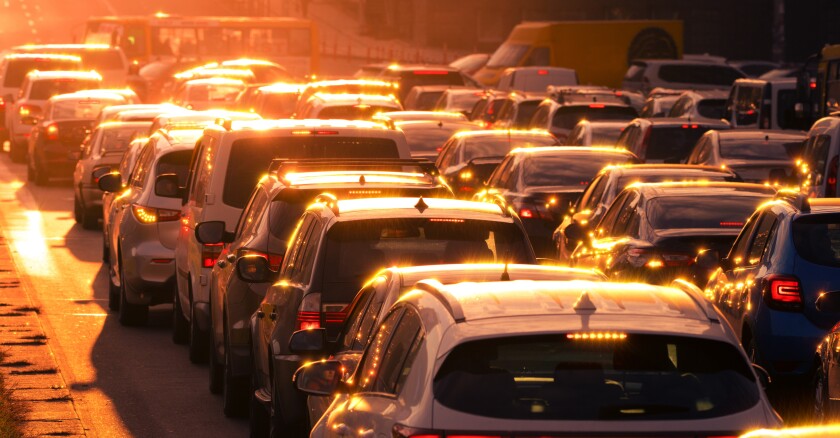
After civil defense sirens sounded Tuesday afternoon, thousands of residents rushed to leave coastal areas, turning Oahu’s roadways into gridlocked corridors. Multihour commutes, stalled intersections and widespread confusion raised new concerns about the state’s ability to move people quickly and safely during a real disaster.
After the first siren sounded just after 3 p.m., cars poured onto the H-1 Freeway and surface streets as residents fled inundation zones.
A drive from Hawaii Kai to Pearl City took more than two hours, and other drivers reported sitting in traffic from Ala Moana to Kalihi for 90 minutes without moving a mile. Images of bumper-to-bumper backups across the island circulated widely on social media, along with confusion over which areas needed to evacuate.
“This is still very, very soon. So it’s not like there’s been a full plan hatched or anything,” said state Sen. Chris Lee, chair of the Senate Transportation and Culture and the Arts Committee.
Lee said the experience—fortunately more of a drill than a true emergency—proved to be a valuable and eye-opening lesson.
“Any time we have an evacuation-type situation, we’re always going to have some type of a traffic issue, especially when you’re trying to get people out of low-lying areas to get farther mauka,” state Department of Transportation Director Ed Sniffen said. “What exacerbated that is it was on top of our normal p.m. peak traffic.”
Sniffen said state and county agencies coordinated signal timing through the Joint Traffic Management Center, sending officers to key intersections to manually direct cars.
In some cases, military police were deployed to assist in areas where police were unavailable, including around Pearl Harbor gates. On the Leeward Coast, the military also opened Kolekole Pass—typically closed to civilians—around 3 :20 p.m. to provide an alternate evacuation route. About 400 vehicles used the mountain road before it closed again at 8 :15 p.m. due to limited visibility.
Still, the volume of vehicles on the road overwhelmed the system.
“Given the volumes that we have—people trying to evacuate and people trying to get home from work—there has been a lot of traffic, ” Sniffen said. “We’ve gotten reports of people taking 1-1/2 to three hours to get home.”
Sniffen noted that some people who were in safe zones left to shop for supplies or gas, further clogging roads. “Next time … if you’re safe, stay there,” he said. “Let the traffic die down for the people who are trying to get out of those inundation zones … and then make their way home in 20 minutes versus 2-1/2 hours.”
Lee said the incident revealed two key gaps in Hawaii’s evacuation readiness.
“For those communities and areas where there is limited ingress and egress—especially those where there’s just one way in and out—(we need to) make sure that we’re prioritizing those projects,” he said, naming places like Lanikai as high-risk zones.
He also pointed to the dense neighborhoods in urban Honolulu where even a full street grid wasn’t enough to handle the surge.
“Everybody trying to get in their cars and leave at the same time would mean hours to even move a quarter mile,” Lee said. “And in a real emergency situation, that’s obviously way too slow and can mean a whole lot of dead people.”
Both Lee and Sniffen said improvements are already in motion.
DOT is reviewing the incident in a formal “hot wash” process, identifying weak points and exploring more emergency access routes, especially for East Honolulu and Windward Oahu, where evacuation options are limited. Plans include better coordination with military partners, improved public communication and potential investment in emergency-only bypass roads.
Sniffen also stressed the importance of mass transit and noncar evacuation options in future disasters.
“Mass transit is available. Instead of having your car on the road, catch the bus, ” he said. “The city did an amazing job of keeping that transit system running the whole time.”
Lee agreed.
“Cars, in that kind of case, can become death traps,” he said. “That really reinforces the strategy … where much more robust pedestrian, bike and other paths are put in place so people can actually get out of their cars and meaningfully leave.”
Despite the chaos, officials emphasized that no one was injured during Tuesday’s evacuations.
Minor fender-benders and incidents of blocked intersections were reported, but no major accidents occurred.
“It was a really good exercise,” Sniffen said. “We got everybody out of the low-lying inundation areas prior to the event. And when the event came in, nobody got hurt. So this is a great opportunity for us to work out what this emergency response would look like.”
Still, Lee said Tuesday’s gridlock should serve as a wake-up call.
“There haven’t been a lot of events like this for Oahu,” he said. “But the wildfires on Maui are another example of what can happen very, very fast. These aren’t luxuries—they’re necessities. And if we ignore them, we’ll regret it.”
© 2025 The Honolulu Star-Advertiser. Distributed by Tribune Content Agency, LLC







