Preparedness and Communications
Latest Stories
-
 The incident is affecting the towns of Pepperell, Dunstable, Townsend and Ashby. It has taken down emergency and business phone lines for police, fire, and emergency medical services departments, but not 911.
 -
If approved, the $41,000 system would not take emergency calls, but would automatically transcribe calls, identify trends and evaluate dispatcher performance, replacing a largely manual review process.


More Stories
-
The farther you are from the epicenter, the more warning time you'd probably have. San Francisco is 60 miles away from the epicenter of the 1989 earthquake, which was in the Santa Cruz Mountains.
-
 None of the detection equipment or computer-generated models helped geologists predict the 4.5 magnitude earthquake that rolled through Pleasant Hill, Calif., Monday night. The fault shook 70,000 people in the region.
 -
The “Northern Exposure” exercises are held annually in different Michigan counties. Previous exercises included other communities and scenarios like a nuclear explosion in a suburban community, said guard officials.
-
During and after the shutdown, residents across large swaths of the Bay Area and beyond lashed out against the utility for what many saw as an immense and frightening over-reaction. Will there be future shutdowns?
-
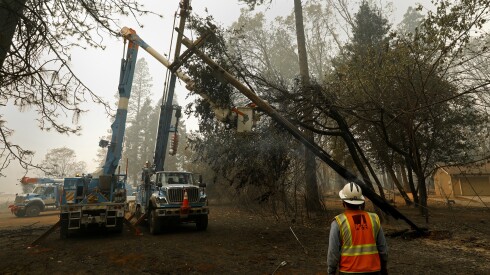
Critics evoked an image of a developing country’s shoddy grid and scolded PG&E for not having a safer system. PG&E said the disruption was needed because of high-wind fire danger and threat of trees slapping power lines.
-
SponsoredPreparing for a major disaster, Florida leveraged Everbridge’s Resident Connection to expand the state’s reach in critical communications during Hurricane Dorian.
-
About 800,000 customers were expected to lose power, leaving them without lights, air conditioning, computers and refrigerators. PG&E fears windblown electrical lines could spark fires if power isn’t cut.
-
With 40-70 mph wind expected over sunbaked land Wednesday and Thursday, the state’s largest utility preemptively cut power in parts of 34 counties. PG&E was driven into bankruptcy for liabilities for the 2017 wildfires.
-
Unreliable communications make disaster recovery more dangerous, and for state, local and federal first responders, a decentralized communication system enables low-cost, long-range connectivity and situational awareness.
-
The data, known as Atlas 14, revealed that parts of Austin are seeing as much as three inches more rain in major storm events than the NOAA had calculated with old rainfall data back in 1961.
-
A Junction City, Ore., school and local police had a drill that went poorly in the spring. But district administration and PD leaders have met to review procedures used in schools in case of a lockdown or lockout.
-
Sutter County, Calif., residents who have the Code Red app are not included in the county’s alert system and are being encouraged by emergency operations manager Zachary Hamill to sign up online through the county.
-
The North Carolina airport is conducting a disaster drill to test emergency protocols. A disaster drill simulating an aircraft emergency is required by the Federal Aviation Administration every three years.
-
The $8,465,000 grant amounts to more than 8 percent of the entire townwide conversion to underground utilities, which the town estimates will cost $102 million, said Steven Stern, underground utilities program manager.
-
Steve Landers started with a two-way, amateur (ham) radio club that felt like family, led to participation in disaster response that continued through a lifetime of emergencies and disasters in Macon-Bibb County, Ga.