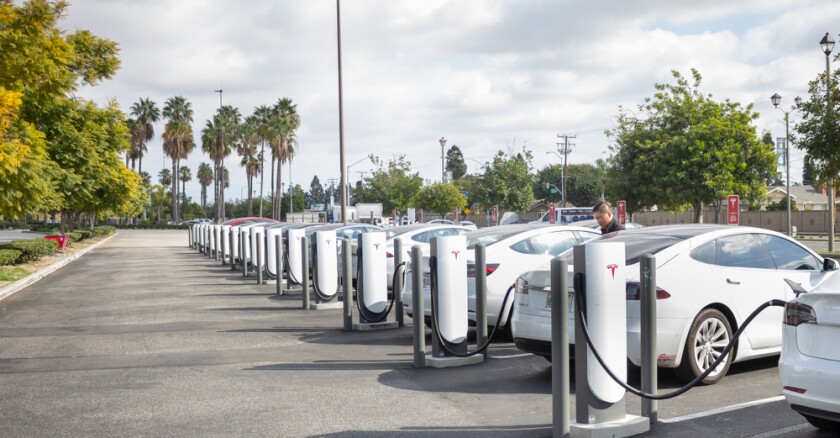
It could happen at a Tesla Supercharger plaza at a shopping center. This public-sector charging model is being developed by Pasadena, Calif., where officials are devising additional charging options for the growing EV fleet and looking for opportunities to increase resiliency as a part of disaster planning.
“As everyone kind of knows, Pasadena was part of these fires last year in January, and we realized very quickly that we need to be a little bit more flexible in how we operate, especially during emergency situations,” Evan Johnson, Pasadena electrification program manager, said Feb. 26 during a panel discussion organized by Veloz, an EV public policy and advocacy group based in Sacramento, Calif.
Johnson was referring to the catastrophic Palisades and Eaton fires that swept through the Los Angeles region in January 2025. The Eaton Fire, which largely destroyed the city of Altadena, also impacted nearby Pasadena.
Pasadena’s city yards, where fleet vehicles and other equipment are stored, include more than 50 Level 2 chargers and four fast chargers. However, in the next few months, the Pasadena Water and Power Department (PWP) a city-owned and operated public utility, will introduce more flexibility into how it charges the 130 city-operated EVs, Johnson said, by letting them recharge at the roughly 300 PWP-developed public chargers across the city.
“So some folks don’t have dedicated chargers where they park and some do, but the ones that don’t will now have options to utilize any public station under our entire network,” Johnson said. “But we are just starting to work with our new back office provider to basically have a system that any fleet vehicle can charge at any of our public sites, and they still will be recorded for billing purposes later so that we can recapture those costs for our department.”
The idea of sharing charging infrastructure is a concept that is taking off in other Southern California communities. The Helix Water District’s Operations Center in El Cajon, near San Diego, will share its new charging infrastructure — a significant build with 87 high-speed chargers — with other nearby public-sector agencies.
The California Advanced Clean Fleets regulation was a key driver behind the Helix development, set to go online in the coming weeks. It requires that all new fleet vehicles in each class must be zero emission starting in 2030 — an extension from the 2027 deadline the California Air Resources Board made in October.
“So we know this is coming. And we will have the infrastructure not only for us, but for our neighbors, as far as the municipalities go,” Kevin Miller, Helix operations director, said in February.
Creative charging arrangements could become part of the norm as pubic-sector fleets transition away from internal combustion engines. The city of Austin, Texas, has more than 400 EVs in its fleet, and pilots in place to explore the use of electric garbage trucks and police cruisers, according to Bobby Godsey, EV community engagement manager at Austin Energy, a city-operated utility.
And it's not just these vehicles that need charging. There are now numerous Waymo robotaxis on Austin streets, and Capital Metro, the city’s transit provider, has nearly 200 electric buses in procurement with about 45 in operation, Godsey said during the Veloz panel. K-12 schools are also now operating electric buses, and electric delivery vans operated by companies including Amazon add to the charging needs of the Texas capital.
Austin Energy is leading the development of the charging strategy for these fleets.
“There's a lot of power that's going to be invested in these fleets,” Godsey said. “And for us, it's about helping the charging infrastructure and how to right-size that infrastructure, and also, not overbuild or under-build.”