
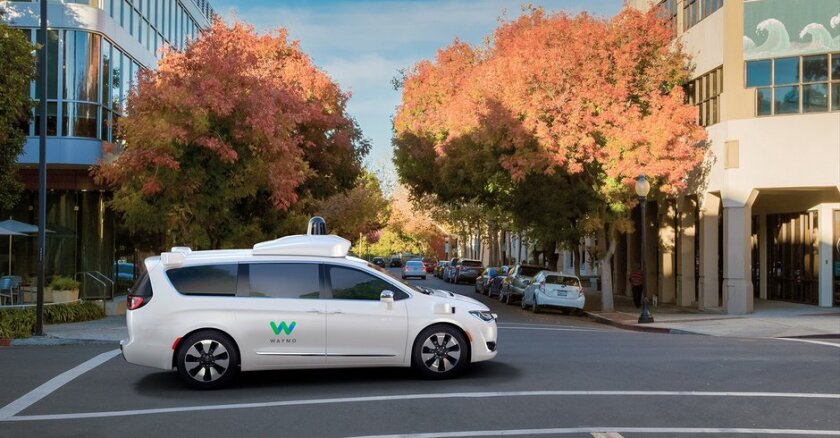
On Wednesday, the autonomous vehicle giant began offering rides to a select group of customers on stretches of Highway 101 and Interstate 280, as well as freeways in Phoenix and Los Angeles. Riders interested in this perk can sign up in the app.
To make this transition more meaningful, Waymo expanded its map in San Jose, creating a seamless 260-square-mile network throughout the Peninsula. And the company added another benefit: Its self-driving cars will pick riders up and drop them off curbside at San Jose Mineta International Airport.
"We've had our eyes on freeways, as I know many of you have had as well, for quite a while," Waymo co-CEO Dmitri Dolgov said during a virtual presentation to reporters. He traced the dream of autonomous freeway driving back to 2009, when engineers at Google launched "Project Chauffeur" by putting lidar sensors on Toyota Priuses.
Over the next 16 years, freeways came to represent a sort of manifest destiny, and a way for Waymo to ensure dominance in the self-driving car market. In September the company won approval to roll out service at San Francisco International Airport, two weeks after securing the same privilege in San Jose. Waymo's Bay Area fleet comprises a thousand vehicles.
When the Chronicle test-rode one of the robotaxis Monday on a circuitous route from San Bruno to South San Francisco to Brisbane, the vehicle handled acceleration and lane changes with all the nimbleness of an experienced driver. Reaching speeds of 65 miles per hour, the car swooshed through interchanges, its steering wheel rotating, almost imperceptibly, from 12 o'clock to 3 o'clock.
At points, the Waymo must have been plainly visible in the rear-view mirrors of other motorists, crawling behind them at 101 on-ramps or exits. Yet it seemed to prompt no reaction — suggesting that in the Bay Area, people may already be accustomed, or simply complacent to this technology.
In at least one instance, the autonomous car showed it could out-perform a human. This occurred as the robotaxi pulled onto 101 South from Brisbane and wound up behind a food truck with its left blinker flashing. After waiting several seconds for the truck to merge, the Waymo eventually concluded that, despite the persistent signal, the driver did not intend to change lanes.
So the Waymo car signaled and passed the truck on the left, providing a clear view to the truck's driver side window. Inside, the driver was steering with one hand and holding a cell phone to his ear with the other.
He appeared not to notice that the car beside him had nobody at the wheel.
Representatives of Waymo have long withstood scrutiny of the company's safety record, even publishing an independent third-party audit earlier this month. They say the freeway launch required rigorous preparation, including simulation of dangerous scenarios — like an overturned car or a lane-splitting motorcyclist — in a closed testing facility.
"And in simulation, we take it even further. We can replay real-world and closed course events or generate completely synthetic scenarios, and then re-run them over and over, tweaking different variables to see how the system responds," principal software engineer Pierre Kreitmann explained during the media briefing.
Bracing for all possible contingencies, Waymo tested what would seem like a nuclear disaster for a car powered by sensors and software: A computer crashing. Since the car runs on dual systems, senior director of engineering Nick Pelly said, a backup takes over and leads the vehicle to an exit.
"The human equivalent might be suddenly losing half your vision and brain capacity, yet still driving safely," Pelly said.
Company spokespeople often emphasize that a driver powered by artificial intelligence will never be intoxicated, distracted or bored. These cars avoid making "emotional decisions," said Waymo group product manager Jacopo Sannazzaro Natta. They certainly will never be caught talking on a cell phone, much less holding one.
The test ride on Monday seemed to underscore this point.
©2025 the San Francisco Chronicle, Distributed by Tribune Content Agency, LLC.


![Nevoya Truck Charging with Greenlane [Colton, CA].jpg](https://erepublic.brightspotcdn.com/dims4/default/5b401fc/2147483647/strip/true/crop/4032x2298+0+363/resize/100x57!/quality/90/?url=http%3A%2F%2Ferepublic-brightspot.s3.us-west-2.amazonaws.com%2F18%2Ff8%2Fa23726324b8a81a6fbe7393fc37e%2Fnevoya-truck-charging-with-greenlane-colton-ca.jpg)









