

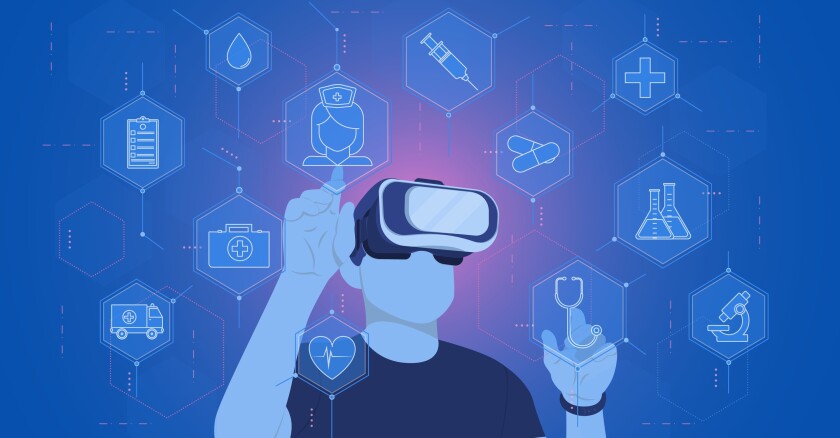
"The Jetsons is becoming more and more the reality," said Superintendent Michael Douglas.
Decatur City Schools is among only five school systems recently chosen statewide by the Legislature to try the program.
Douglas said it is for middle through high school, specifically grades 7 through 10.
The idea was presented last week at the Decatur City Schools board meeting. School board members voted 4-0 to approve a memorandum of agreement between the school system and the company providing the service — Prisms of Reality.
Bryan Keenum, technology coordinator for Decatur City Schools, briefly described how the program works.
"It is an opportunity for these students in a class — particularly math and science — to experience real-world scenarios in virtual reality."
Students put on the headset and have two controllers (one in each hand), and for about 20 to 30 minutes of the class period they will interact where they are exposed to a job in a real-world market that may not be familiar to them, Keenum said.
"We are all familiar with lawyer, doctor, nurse, teacher, but they may be exposed to a lab tech or an inventory manager at a warehouse," Keenum said. "There are different environments where they will be immersed. This headset will reinforce a concept they have learned during a class period."
Prisms will provide each school with a headset and a charging cart and the contract will be good for the rest of the school year. The only cost this first year is for batteries, he said.
Using the data collected during a session they will determine if students who were not being reached have been reached, he said.
Prisms is a spatial learning platform that uses immersive virtual reality to transform how K-12 students learn core math and science concepts by allowing them to physically interact with abstract ideas in real-world scenarios, according to the Prisms website.
Teachers plan for and orchestrate the students' experience in real time through their Prisms Teacher Dashboard. Students sign into the headset using their unique credentials to save their progress and provide analytics to teachers and districts, according to the website.
Board members were impressed with the technology.
"It was very interesting to me, so I think it will be of interest to kids," District 2 board member Peggy Baggett said of the technology after the meeting. "It's right where their minds focus and I think it is going to be important to them in the future."
Michele Gray King, board president, said after the meeting, "I think it is a good program and I'm honored we were considered. It's a perfect opportunity for our children."
She noted that although Decatur is a larger school system than some of the others that were chosen it has some of the same demographics.
District 5 board member Jason Palmer said after the meeting he is looking forward to seeing how it works out.
"Just the virtual reality of being able to experience careers in the classroom is interesting," he said. "I think kids will become better conceptual learners. Kids want to know why, so anytime we can give them a visual it is helpful."
He speculated on the future of such virtual reality tools, saying, "Pretty soon you will be able to be inside a cell and see the mitochondria and the nucleus."
Also Wednesday, the board was able to see how artificial intelligence software gathered all of the board meeting minutes for the past six months and turned them into a report on what actions the board took in that time frame. It took the software about 10 minutes to sort through the notes and create the report.
Douglas explained how students might use artificial intelligence in a similar manner.
"You don't use AI to create a report for class but to proof what you have written," Douglas said.
In other words, students need to do the work of creating their own reports and then use AI for spelling, grammar and other criteria such as how the paper is to be organized.
© 2025 The Decatur Daily (Decatur, Ala.). Distributed by Tribune Content Agency, LLC.









