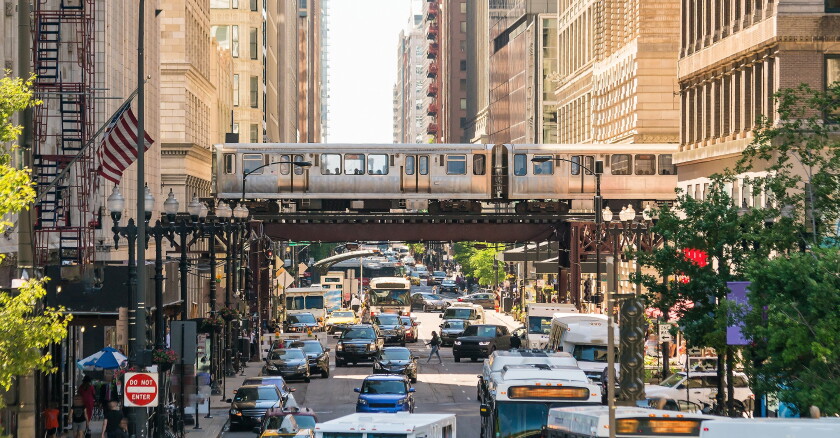
Traffic congestion in the United States was 11 percent higher in 2025 than last year, according to a new report by INRIX.
“VMT so far, is at a record pace,” Bob Pishue, a senior economist and transportation analyst at INRIX, said during a video conference Wednesday with reporters to discuss the 2025 Global Traffic Scorecard, using the shorthand for “vehicle miles traveled,” a key mobility metric.
“It is outpacing 2019 levels,” he said. “So people in the U.S. have never driven this amount before. We’ve driven now more than ever.”
In the U.S., drivers lost some 4.7 billion hours due to traffic last year — 2,080 hours per job, per year — costing the economy $86 billion, according to the annual INRIX study. The Chicago metropolitan region surpassed the New York City region as the most congested in the nation, followed by Philadelphia in the No. 3 spot. Los Angeles dropped a rung to fourth place, and Boston landed at No. 5.
This finding is in keeping with other major mobility studies. Transportation experts with McKinsey say private cars still dominate mobility in the United States, in Europe and, to a lesser extent, in Asia. Some 96 percent of trips in the U.S. occur via private autos, Darius Scurtu, expert and engagement manager with the McKinsey Center for Future Mobility, said during a Nov. 20 webinar on McKinsey’s Mobility Market Model for 2025.
However, even as some cities like Philadelphia, Baltimore and Austin have experienced significant, double-digit growth in traffic congestion in the last year, other major cities seem to be leveling out. Traffic congestion in the New York City region was flat in the last year — neither increasing, nor decreasing. And traffic in Los Angeles, a city known for its iconic freeways, declined 1 percent compared to last year, according to the INRIX study.
The congestion pricing program introduced in Manhattan earlier this year is likely contributing to some of the city’s traffic calming, Pishue said. However, he was careful to not overstate the effects of a measure that could be impacting a relatively small section of the region.
“It’s hard to tell how much [impact] the pricing has on the entire region. It’s probably relatively small,” Pishue said. “I do think there’s something to these large urban metros — dense urban metros — either staying the same or falling in traffic congestion. And so, it may be part of a trend. But congestion pricing, it’s hard to say it didn’t have an effect on New York [City] traffic.”
McKinsey officials say they do not expect private car use to climb much further.
“We see other modes of transport cannibalizing private cars,” Scurtu said. “Think about autonomous vehicles. Think about also, non-autonomous shared mobility.”
These modes also end up in the traffic mix, often adding to congestion, along with other trends like new ways of package delivery. And even small increases in traffic volume are felt more significantly, in part, because infrastructure is not keeping pace with vehicle use, Pishue said.
“It’ll be interesting to see what goes on with deliveries and freight demand. I think that is probably a bigger part of this,” he said.
Complicating the U.S. traffic picture even further, transit ridership remains 20 percent below 2019 pre-COVID-19 levels, according to INRIX research, an indication remote work is still competing with transit trips. By 2024, 13.3 percent of workers worked remotely, down from 13.8 percent in 2023, according to research by Yardi Kube, a coworking management platform.