

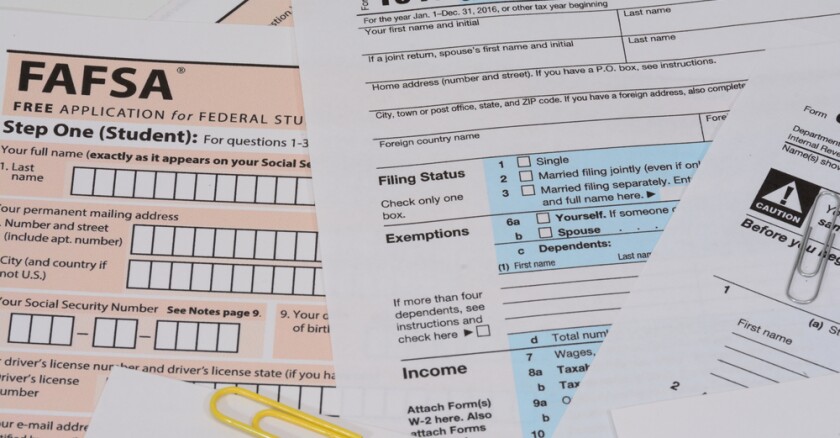
Yesterday the U.S. Department of Education (ED) initiated a broad campaign to detect and prevent fraud within the Free Application for Federal Student Aid (FAFSA) application pipeline. Those who fill out the form may now face real-time identity screening and stricter verification requirements, according to a news release Monday.
Though not required for any student, FAFSA is the primary form students complete to access federal government funding for higher education, including grants, loans and work-study opportunities. ED's website says it's the largest source of academic financial aid in the U.S.
Beyond supporting students with financial aid, states and institutions also utilize FAFSA data — e.g., family income, student grade-point averages and geographic information — to determine how much aid a student qualifies for.
WHAT IS HAPPENING TO FAFSA?
The government expressed that student aid fraud has become a serious problem, citing an analysis by the nonprofit National Association of Student Financial Aid Administrators (NASFAA) that revealed approximately $90 million in FAFSA dollars were sent to ineligible recipients over the past three years. In a December 2025 statement, ED claimed tightened security measures implemented by the federal government intercepted more than $1 billion in fraudulent aid requests. According to this week's news release, “highly sophisticated fraud rings, ‘ghost students,’ and AI bots” have wrongfully received money from FAFSA.
“This new fraud detection tool will stop fraud at the start of the process, before money goes out the door, strengthening the integrity of our programs and expanding opportunity for students who depend on these resources to finance their postsecondary education,” U.S. Secretary of Education Linda McMahon said in a public statement.
The news release said anti-fraud technology is now embedded directly into FAFSA, and students may now be required to prove their identity through ID checks and additional screenings, with the system identifying suspicious applications in real time, not unlike the fraud detection systems used for credit cards.
The government is reportedly increasing its coordination with other federal agencies to flag and resolve discrepancies before aid is disbursed, including a bolstered partnership with the Social Security Administration, which is specifically intended to prevent payments from being issued to deceased people — a loophole that has reportedly cost taxpayers tens of millions of dollars.
The news release mentioned two other maneuvers by federal officials: They're working in tandem with the Department of Homeland Security to immediately confirm the eligibility status of applicants upon the form’s submission, and ED resumed automated post-screening of student aid records, hoping to prevent overpayments and enforce lifetime limits on federal Pell Grants.
While intended to ensure that federal money reaches legitimate students rather than scammers or other fraudulent entities, there is concern regarding the friction these safeguards add to the FAFSA application process.
NASFAA has warned that increased security measures can accidentally exclude or delay legitimate students from filling out the form, creating barriers, especially for students with fewer resources or those lacking documentation.
"Each year, the Department of Education selects millions of applications for further review. For those selected applications, schools are required to validate the submitted information to ensure accuracy of both the FAFSA data and the financial aid awarded," the NASFAA report said. "This additional step in the aid application process is called 'verification,' and remains a complicated and time-consuming burden for the students and families who are most in need of financial aid."









